Reese’s Law requires any US consumer product that contains or is designed to use a button cell or coin battery to meet the product safety standard ANSI/UL 4200A, and it requires retail packages of those batteries to carry a set warning label. The rule is 16 CFR Part 1263, and it covers products whether the battery is built in, replaceable, included, or sold separately. Two dates apply to different things: October 23, 2023 is the effective date for the product requirement, and September 21, 2024 is the cutoff for battery packaging labels (packages manufactured or imported after that date must comply).
This guide sets out the rule’s tests so you can check your own listings; it does not decide whether any specific product complies. Sources: the eCFR text of 16 CFR Part 1263 and CPSC’s Button Cell and Coin Battery Business Guidance page (both data checked 2026-10-09).
What Reese’s Law Is: Two Sections, Two Rule Sets
Reese’s Law is Public Law 117-171, codified at 15 U.S.C. 2056e. CPSC’s business guidance splits it into two parts, and Amazon sellers can fall under either one:
- Section 2: products containing or designed to use button cell or coin batteries. This is the part carried out by 16 CFR Part 1263. It covers the product standard (§1263.3) and the warning label on battery packaging (§1263.4).
- Section 3: packaging for the batteries themselves. CPSC’s page says button cell or coin batteries that are sold, distributed, or imported into the United States, “or included separately with a consumer product,” must use packaging that meets 16 CFR §1700.15, which is the child-resistant special packaging standard under the Poison Prevention Packaging Act.
Under §1263.1(a), Part 1263 is meant “to eliminate or adequately reduce the risk of injury and death to children 6 years old and younger from ingesting these batteries.” Hence the rule’s shape: keep the battery inside the product, keep loose batteries inside the package, and warn on everything a parent handles.
Is Your Product Covered by 16 CFR 1263?
There are two questions: is the cell a “button cell or coin battery,” and is your item a product “containing” one?
The battery test. §1263.2 defines a button cell or coin battery as “a single cell battery with a diameter greater than the height of the battery,” or any other battery the Commission determines poses an ingestion hazard. The test is shape, not chemistry: lithium coin cells, silver-oxide watch cells, and alkaline button cells all pass it.
The product test. §1263.2 defines a consumer product containing button cell or coin batteries as one “containing or designed to use one or more button cell or coin batteries, regardless of whether such batteries are intended to be replaced by the consumer or are included with the product or sold separately.”
So a product shipped without a battery is still in scope if it is designed to take one.
| What you sell | Battery situation | Part 1263 product rule (§1263.3) | Section 3 child-resistant battery packaging |
|---|---|---|---|
| Gadget with a sealed, non-replaceable coin cell | Built in | In scope | Not applicable (no loose battery) |
| Remote, scale, or tracker with a replaceable coin cell, battery installed | Replaceable | In scope | Not applicable unless a spare ships separately |
| Product designed for a coin cell, shipped without one | Sold separately | In scope | Not applicable to you; applies to whoever sells the battery |
| Product with a spare coin cell in its own blister in the box | Included separately | In scope | Applies to the spare battery’s package |
| Retail pack of coin cells | Battery only | §1263.4 label rule applies to the package | Applies |
| Toy for under-14s that complies with 16 CFR 1250 battery rules | Any | Exempt (§1263.1(c)) | See CPSC guidance |
| Hearing-aid-type zinc-air cells | Zinc-air | Excluded (§1263.1(d)) | Still applies, per CPSC |
What Is Excluded: Toys and Zinc-Air Batteries
Part 1263 lists two exclusions.
Children’s toys under 16 CFR Part 1250. §1263.1(c) exempts “any object designed, manufactured, or marketed as a plaything for children under 14 years of age that is in compliance with the battery accessibility and labeling requirements of 16 CFR part 1250.” The exemption depends on actually meeting Part 1250’s battery provisions; toys also carry their own Children’s Product Certificate duties.
Zinc-air cells. §1263.1(d) says batteries the Commission has determined do not present an ingestion hazard “are not subject to this part,” and it names one category: “zinc-air button cell or coin batteries.” The exclusion covers Part 1263 only. CPSC’s guidance says zinc-air cells still fall under the Section 3 special-packaging requirement, and that CPSC used enforcement discretion so that zinc-air special packaging “will not be enforced until March 8, 2024.”
Lithium coin cells get no exemption; Part 1263 applies alongside the separate shipping rules in Amazon FBA lithium battery requirements.
The Product Standard: ANSI/UL 4200A
§1263.3 is a single requirement: “Each consumer product containing button cell or coin batteries shall comply with ANSI/UL 4200A, Standard for Safety for Products Incorporating Button Batteries or Coin Cell Batteries, approved on August 30, 2023.” The standard is incorporated by reference, not reproduced in the CFR; §1263.3 notes a free read-only copy on UL’s website.
CPSC’s business guidance summarizes the requirements (quoted exactly):
- Battery compartments holding replaceable cells must be secured so “they require the use of a tool or at least two independent and simultaneous hand movements to open.”
- Products “must not allow such batteries to be accessed or liberated as a result of use and abuse testing.”
- “The packaging for the overall product must bear a warning.” and “The product itself must bear a warning, if practicable.”
- “Accompanying instructions and manuals must include all of the applicable warnings.”
Test methods, product warning wording, and pass/fail criteria live in UL 4200A itself, so read them from the standard and the lab report. The practical step: get a UL 4200A test report naming your exact model, and check that the tested sample matches what you ship, including the compartment screw and the battery.
The Battery Packaging Warning Label Under 16 CFR 1263.4
§1263.4 governs labels on packages of button cell or coin batteries, not the outer box of a remote control (that box falls under UL 4200A). It applies if you sell battery multipacks or ship a separately packaged spare cell.
Format rules in §1263.4(a):
- Warning statements must be “clearly visible, prominent, legible, and permanently marked,” in a color that contrasts with the background, and “in English.”
- The safety alert symbol (an exclamation mark in a triangle) comes before the signal word, sits on the same baseline, and is at least as tall as the letters.
- “WARNING” and the symbol are black on orange unless that conflicts with the contrast rule or only one color is present; the signal word is upper-case sans serif.
- Minimum text sizes follow Table 1 of §1263.4(a)(7) by display area. Over 5 and up to 10 square inches: 3/32 inch for the signal word, 1/16 inch for the hazard statement and other text.
Placement rules in §1263.4(b):
| Package situation | Principal display panel (usually the front) | Secondary display panel (usually back or side) |
|---|---|---|
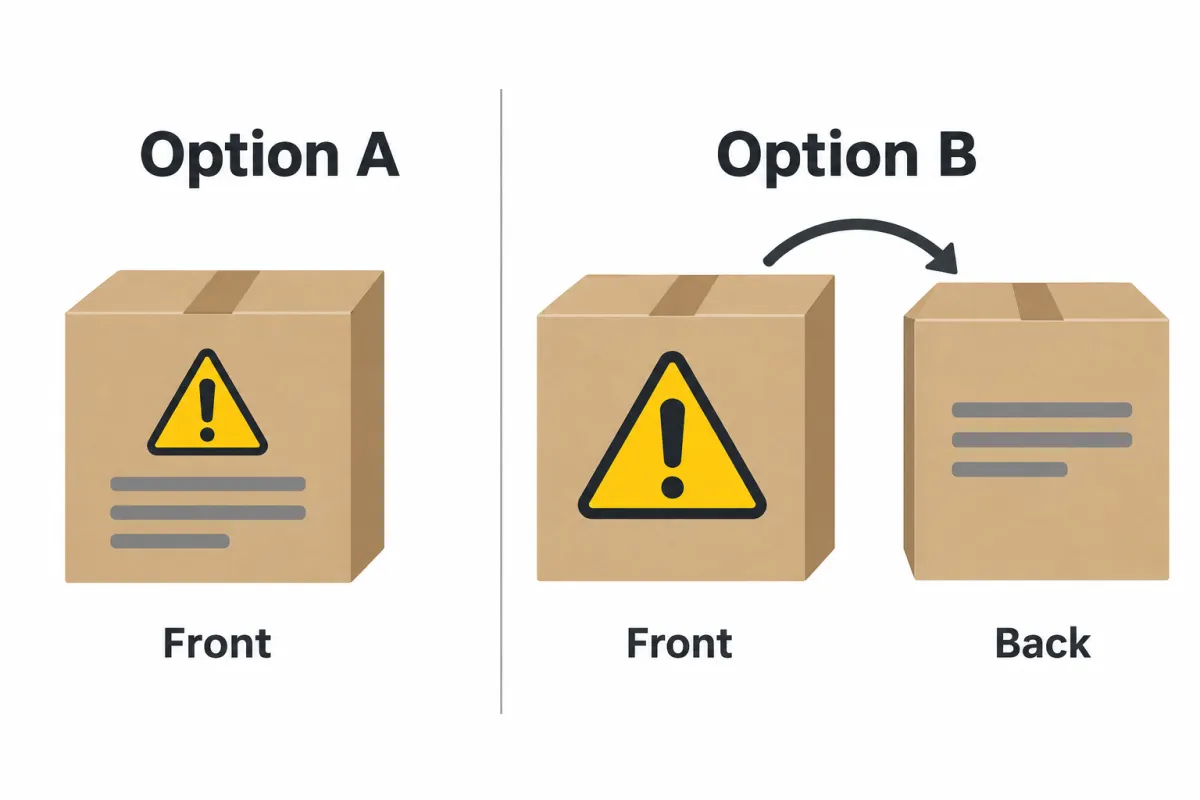
| Room for the full label | Full warning label from Figure 1, with an icon at least 8 mm (0.3 inches) in diameter | Not required for the label |
| Not enough room for the full label | Icon from Figure 2, at least 20 mm in diameter | Warning text from Figure 3 |
| Either case | Two safety statements, on either panel | Two safety statements, on either panel |
The two safety statements required by §1263.4(b)(3) are: “Keep in original package until ready to use.” and “Immediately dispose of used batteries and keep away from children. Do NOT dispose of batteries in household trash.”
For a battery package included separately with a consumer product, §1263.4(b)(4) says “only paragraphs (b)(1) and (2) of this section apply,” so the two statements are not required there. Figures 1 and 3 are published as images, so take the exact label wording from the eCFR or 88 FR 65303, not a supplier’s artwork file.
Child-Resistant Packaging for the Batteries Themselves
Section 3 of Reese’s Law sets a separate requirement from §1263.4. The battery package must be child-resistant, not only labeled. CPSC’s guidance says Section 3 requires packaging that “meets the requirements of 16 CFR § 1700.15,” and that “any subject product manufactured or imported after February 12, 2023, must meet this packaging requirement.”
That covers retail coin-cell packs and loose spare cells packed inside a product box. A spare cell dropped loose into a polybag with the product meets neither Section 3 nor the §1263.4 label rule. CPSC also notes that testing to the Section 3 special-packaging requirement “is not required to be conducted by a third-party, CPSC-accepted laboratory.”
Reese’s Law Compliance Dates: Products vs Battery Packaging
The rule has several dates that apply to different things. Do not combine them.
| Requirement | Date | Trigger | Source |
|---|---|---|---|
| Section 3 child-resistant battery packaging (16 CFR 1700.15) | February 12, 2023 | Manufactured or imported after this date | CPSC guidance |
| §1263.3 product standard (UL 4200A), effective date | October 23, 2023 | Effective date in §1263.1(b) | eCFR |
| Third-party testing and certification for children’s products under Part 1263 | December 20, 2023 | Not required until on or after this date | CPSC guidance |
| Zinc-air special packaging enforcement | March 8, 2024 | Not enforced until this date | CPSC guidance |
| §1263.3 product requirements, under CPSC enforcement discretion | March 19, 2024 | Manufactured or imported after this date | CPSC guidance |
| §1263.4 battery packaging warning label | September 21, 2024 | Packages manufactured or imported after this date | eCFR §1263.1(b) |
All dates data checked 2026-10-09; every one has passed, so units imported today must meet every requirement that applies.
Certificates: GCC or CPC and the Exact Citations
CPSC’s guidance says Section 14(a) of the Consumer Product Safety Act requires manufacturers of regulated products to certify compliance. That means a General Certificate of Compliance (GCC) for general-use products, or a Children’s Product Certificate (CPC) for children’s products. CPSC lists these citation strings to use on the certificate:
- “16 CFR § 1263.3 – Consumer products containing button cell or coin batteries”
- “16 CFR § 1263.4 – Button cell or coin battery package labeling”
- “15 U.S.C. § 2056e – Button cell or coin battery packaging”
A general-use remote with an installed coin cell would usually cite §1263.3. Add §1263.4 and the Section 3 citation if a separately packaged spare ships in the box. For how certificate data is filed with CPSC at import, see CPSC eFiling for Amazon importers.
Seller Checklist
- List every SKU that contains, includes, or is designed to use a cell whose diameter is greater than its height. Include products shipped without a battery.
- For each SKU, mark which exclusion applies, if any: a Part 1250-compliant toy, or zinc-air.
- Get a UL 4200A test report that names the exact model, and confirm the compartment and the battery match production.
- Check that the warnings on the product, the product packaging, and the manual match what UL 4200A requires.
- For any separately packaged cell, confirm child-resistant packaging (16 CFR 1700.15) and §1263.4 label placement.
- Issue or collect a GCC or CPC with the CPSC citation strings listed above.
- Keep the report and certificate where you can produce them quickly. If Amazon asks for compliance documents, our Manage Your Compliance guide covers the dashboard where they go.
Common Mistakes
- Treating “battery not included” as out of scope. §1263.2 covers products “designed to use” a button cell.
- Combining the two dates. October 23, 2023 applies to products. September 21, 2024 applies to battery packaging labels.
- Assuming a children’s product is automatically exempt. The toy exemption requires compliance with 16 CFR 1250’s battery rules.
- Assuming zinc-air means no rules apply. Zinc-air cells are outside Part 1263 but not outside Section 3 packaging.
- Mixing up Reese’s Law and dangerous-goods shipping. UN38.3 and FBA hazmat review are separate tracks; see Amazon hazmat review.
- Missing incident reports. A battery ingestion report may trigger a Section 15(b) reporting duty.
Frequently Asked Questions
Does Reese’s Law apply if my product ships without a battery?
Yes, if the product is designed to use a button cell or coin battery. §1263.2 covers products “regardless of whether such batteries are intended to be replaced by the consumer or are included with the product or sold separately.”
What is the difference between 16 CFR 1263.3 and 1263.4?
§1263.3 requires products containing button or coin cells to meet ANSI/UL 4200A. §1263.4 sets the warning label on packages of the batteries themselves, including a spare cell packaged separately with a product.
How big must the warning icon be on coin battery packaging?
At least 8 mm (0.3 inches) in diameter when the full label fits on the principal display panel. If space forces the split layout, the icon on the principal display panel must be at least 20 mm in diameter, with the text on the secondary panel (§1263.4(b), data checked 2026-10-09).
Do I need third-party lab testing?
For children’s products under Part 1263, yes, from December 20, 2023, per CPSC. For Section 3 special packaging, CPSC says a CPSC-accepted third-party lab is not required.
Conclusion
Reese’s Law asks three questions about every SKU. Does it contain or use a cell wider than it is tall? If it does, does it meet UL 4200A, with warnings on the product, packaging, and manual? Does any loose battery come in child-resistant packaging with the §1263.4 label? Check them in that order and keep the test report and certificate for each SKU.