Under the FTC’s Energy Labeling Rule (16 CFR Part 305), a website that sells a covered appliance must show, for each model, a legible image of its EnergyGuide or Lighting Facts label, placed clearly and conspicuously near the price. Covered plumbing products such as showerheads, faucets, and toilets need a water-use disclosure instead, and certain fluorescent lamps, ballasts, and metal halide fixtures need a circled capital “E.” The rule names manufacturers, private labelers, distributors, and retailers as the parties who can be responsible.
This guide maps §305.27 onto an Amazon listing. It does not decide whether a specific product is covered; it gives the categories and definitions the rule uses. All rule text below was read from the eCFR on 2026-10-10.
What the Energy Labeling Rule Requires Online
Part 305 is the FTC’s rule under the Energy Policy and Conservation Act (42 U.S.C. 6294 is listed as its authority in the eCFR, data checked 2026-10-10). Most of the rule covers the physical label on the product. The online duty comes from one definition and one section.
The definition is “catalog.” §305.2(h) defines a catalog as “printed material, including material disseminated over the Internet, which contains the terms of sale, retail price, and instructions for ordering, from which a retail consumer can order a covered product.” An Amazon product page shows a price, terms of sale, and a way to order, which are the elements that definition lists.
The section is §305.27, titled “Paper catalogs and websites.” Its paragraph (a) applies to “Any manufacturer, distributor, retailer, or private labeler who advertises a covered product on an Internet Web site in a manner that qualifies as a catalog under this Part.” It then sets two things: content (what must be shown) and format (where and how).
One difference from paper catalogs matters for sellers. §305.27(b) lets a paper catalog choose between the full label image and a text disclosure of capacity and operating cost. §305.27(a) gives websites no text option for label-bearing products: the website “must display, for each model, a recognizable and legible image of the label required for that product by this part.”
This is a separate topic from environmental marketing claims. Words like “eco-friendly” or “recyclable” fall under the FTC Green Guides, covered in our Green Guides guide for Amazon listings. Amazon’s own sustainability badge is a different program again, explained in our Climate Pledge Friendly guide.
Which Products Need an EnergyGuide Label Image Online
§305.27(a)(1) splits covered products into two groups: products that carry an EnergyGuide or Lighting Facts label, and products that do not but still need a disclosure. The table lists every product type named in §305.27(a)(1), as read on 2026-10-10.
| Product type named in §305.27(a)(1) | What the listing must show | Where the product is described in Part 305 |
|---|---|---|
| Refrigerators, refrigerator-freezers, freezers | EnergyGuide label image, per model | §305.3(a), (b) |
| Room air conditioners, portable air conditioners | EnergyGuide label image, per model | §305.3(e), (j) |
| Clothes washers, dishwashers | EnergyGuide label image, per model | §305.3(f), (c) |
| Water heaters, pool heaters | EnergyGuide label image, per model | §305.3(d), (i) |
| Ceiling fans | EnergyGuide label image, per model | §305.3(g) |
| Televisions | EnergyGuide label image, per model | §305.3(h) |
| Central air conditioners, heat pumps, furnaces | EnergyGuide label image, per model | §305.4(a)-(c) |
| General service lamps; specialty consumer lamps (offered for sale after May 2, 2018) | Lighting Facts label image, per model | §305.5(c), (j) |
| Showerheads, faucets, water closets (toilets), urinals | Water use in gpm and L/min, gpc and L/cycle, or gpf and Lpf | §305.6(a)-(d) |
| General service fluorescent lamps, fluorescent lamp ballasts, metal halide lamp fixtures | A capital letter “E” printed within a circle | §305.5(b), (a), (i) |
Whether a given model falls inside a category depends on the definitions in §§305.3-305.6, which carry technical limits. For example, §305.3(d) covers gas storage water heaters only “with an input of 75,000 Btu per hour or less” (data checked 2026-10-10).
For label-bearing products, §305.27(a)(1)(i) allows a shortcut: “The website may hyperlink to the image of the label using the sample EnergyGuide and Lighting Facts icons depicted in appendix L of this part.” The same sentence group adds a condition: “The website must hyperlink the image in a way that does not require consumers to save the hyperlinked image to view it.”
Water-Use and “E” Disclosures for Products Without a Label
Plumbing products and some lighting products do not carry an EnergyGuide-style label, but §305.27(a)(1)(ii) still requires a listing disclosure “for each covered product.”
For showerheads, faucets, water closets, and urinals, §305.27(a)(1)(ii)(A) requires “The product’s water use, expressed in gallons and liters per minute (gpm and L/min) or per cycle (gpc and L/cycle) or gallons and liters per flush (gpf and Lpf) as specified in this part.” Note that both units are named: a showerhead listing that shows only gallons per minute leaves out the liters figure the rule lists.
The rule allows a link here too. For plumbing products, “the Web site may hyperlink to the disclosures using a prominent link labeled “Water Usage” or a similar description which facilitates the disclosure of the covered product’s rated water usage.”
For general service fluorescent lamps, fluorescent lamp ballasts, and metal halide lamp fixtures, §305.27(a)(1)(ii)(B) requires “A capital letter “E” printed within a circle.” This symbol is separate from the Lighting Facts label that general service lamps carry, and a seller of mixed lighting lines may need both kinds of disclosure across different listings.
Where the Label Must Sit on a Listing
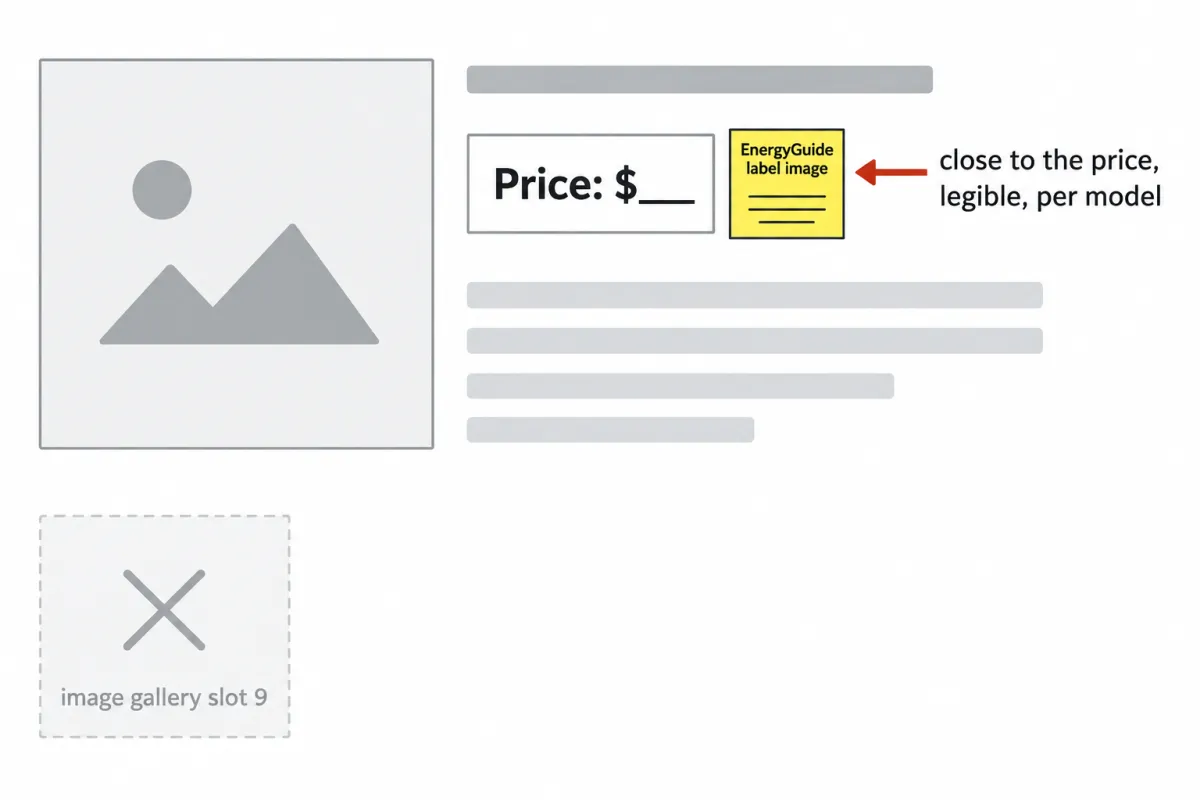
§305.27(a)(2) sets the format. The required disclosures, “whether label image, icon, or text, must appear clearly and conspicuously and in close proximity to the covered product’s price on each Web page that contains a detailed description of the covered product and its price.”
- Proximity to price. The rule ties placement to the price, not to the image gallery or the bottom of the page.
- Every detail page. The duty attaches to “each Web page that contains a detailed description of the covered product and its price.” If the same model appears on more than one detail page, each one is in scope by that wording.
- Size can change, legibility cannot. The label and icon “must conform to the prototypes in appendix L, but may be altered in size to accommodate the Web page’s design, as long as they remain clear and conspicuous to consumers viewing the page.” A thumbnail too small to read the cost figures fails the “recognizable and legible” test in paragraph (a)(1)(i).
On Amazon, sellers do not design the product page layout, and several sellers can share one detail page. How the label image gets displayed depends on the listing fields Amazon provides, which sit behind the Seller Central login and are not described here. The rule’s test stays the same whatever the field: legible, per model, and close to the price. If your listing data is incomplete, see our guide to Amazon’s Manage Your Compliance dashboard for where Amazon surfaces compliance requests, and our guide to suppressed listings if a listing has been pulled for missing attributes.
Who Is Responsible: Manufacturer, Private Labeler, Distributor, Retailer
§305.27(a) applies to “Any manufacturer, distributor, retailer, or private labeler” whose website qualifies as a catalog. §305.2 defines each role, and the definitions matter for Amazon sellers because they do not map neatly onto “brand” and “reseller.”
| Role | Definition in §305.2 (eCFR, data checked 2026-10-10) | Typical Amazon seller fit |
|---|---|---|
| Manufacturer | “any person who manufactures, produces, assembles, or imports a consumer appliance product” | Includes the importer of record for a covered product |
| Private labeler | “an owner of a brand or trademark on the label of a consumer appliance product which bears a private label” | Private-label brand owners |
| Distributor | “a person (other than a manufacturer or retailer) to whom a consumer appliance product is delivered or sold for purposes of distribution in commerce” | Wholesale intermediaries |
| Retailer | “a person to whom a consumer appliance product is delivered or sold, if such delivery or sale is for purposes of sale or distribution in commerce to purchasers who buy such product for purposes other than resale” | Resellers selling to end consumers |
Private-label sellers tend to miss the import clause: a brand that imports a portable air conditioner under its own trademark fits both “manufacturer” and “private labeler.”
The prohibited-acts section ties the online duty to all four roles. §305.7(b) opens: “it shall be unlawful for any manufacturer or private labeler knowingly to:” and item (b)(5) reads “Distribute in commerce any catalog containing a listing for a covered product without the information required by § 305.27 of this part. This subsection shall also apply to distributors and retailers.” The knowledge standard is written for manufacturers and private labelers; the rule text does not restate it for the sentence extending (b)(5) to distributors and retailers.
Safety and liability duties use their own role definitions; see our GPSR guide and product liability insurance guide.
Getting the Label Image: The Manufacturer’s Website Duty
A retailer cannot display a label it does not have. §305.9 handles this: “For each covered product required by this part to bear an EnergyGuide or Lighting Facts label, the manufacturer must make a copy of the label available on a publicly accessible website in a manner that allows catalog sellers to hyperlink to the label or download it for use in websites or paper catalogs.”
It also sets a retention period: “The label for each specific model must remain on the website for six months after production of that model ceases.” §305.7(b)(6) makes failing to do so a prohibited act and states “This provision applies only to manufacturers.”
For a reseller, the practical source is the manufacturer’s published label for the exact model number. For a private-label importer who counts as the manufacturer, §305.9 means you are the party who must publish the label, not just display it on Amazon.
Penalties
§305.7(b) says its prohibited acts, including the catalog duty in (b)(5), are “Subject to enforcement penalties assessed per model per day of violation pursuant to 42 U.S.C. 6303 and adjusted for inflation by § 1.98 of this chapter.”
16 CFR 1.98 states that its “maximum civil penalty amounts apply only to penalties assessed after January 17, 2025,” and lists “Section 333(a) of the Energy Policy and Conservation Act, 42 U.S.C. 6303(a)—$575” (eCFR, data checked 2026-10-10). The per-model, per-day structure means the figure multiplies by the number of models and days involved. The FTC’s own business guidance pages on ftc.gov blocked automated retrieval on 2026-10-10, so this guide cites the eCFR text only and does not list enforcement cases.
Common Mistakes on Covered Listings
- Text instead of the label. Writing “Estimated yearly cost $XX” in a bullet point is the paper-catalog option in §305.27(b). The website rule in §305.27(a)(1)(i) asks for the label image.
- One label for a whole variation family. The rule says “for each model.” A refrigerator listing with three capacity variations needs the label for each model, not one shared image.
- A link that forces a download. The hyperlink must not “require consumers to save the hyperlinked image to view it.”
- Gallons only for plumbing. §305.27(a)(1)(ii)(A) names both gallons and liters.
- Assuming the importer is not the manufacturer. §305.2 puts importers inside “manufacturer,” which also brings the §305.9 publishing duty.
- Mixing up the labels. EnergyGuide and Lighting Facts are federal disclosures; Amazon badges and green claims are separate.
Checklist Before a Covered Listing Goes Live
- Match each product to a category named in §305.27(a)(1), then read its definition in §§305.3-305.6 in the eCFR.
- Note your role under §305.2: manufacturer (including importer), private labeler, distributor, or retailer.
- Get the label image for the exact model number, or publish it yourself if §305.9 applies to you.
- Confirm the image is legible at the size it displays, one per model.
- Confirm it sits close to the price on every detail page for that model.
- For plumbing, show water use in both unit systems, or a prominent “Water Usage” link.
- For fluorescent lamps, ballasts, and metal halide fixtures, show the circled “E.”
- Recheck when a model changes; labels are model-specific. For listing quality beyond compliance, see our Amazon listing optimization guide.
Frequently Asked Questions
Does an Amazon listing count as a “catalog” under the Energy Labeling Rule?
§305.2(h) defines a catalog as material, “including material disseminated over the Internet,” that contains the terms of sale, retail price, and ordering instructions from which a retail consumer can order a covered product. An Amazon product page contains those elements. §305.27(a) applies to websites that advertise a covered product “in a manner that qualifies as a catalog.”
Can I link to the label instead of showing it on the page?
Yes. §305.27(a)(1)(i) allows a hyperlink using the sample EnergyGuide and Lighting Facts icons in appendix L, as long as consumers do not have to save the image to view it, and the icon sits clearly and conspicuously near the price.
Do LED light bulbs need a label image on the listing?
General service lamps and specialty consumer lamps are named in §305.27(a)(1)(i), which requires a Lighting Facts label image. Whether a particular bulb is a “general service lamp” depends on the definition in §305.5(c).
Who is responsible if the manufacturer never published a label?
§305.9 puts the publishing duty on the manufacturer, and §305.7(b)(6) says that provision “applies only to manufacturers.” The listing duty in §305.27(a) still names distributors and retailers, so a reseller without a label has no image to meet it.
Bottom Line
The online part of the FTC Energy Labeling Rule comes down to §305.27: a legible label image per model for appliances, TVs, heating and cooling equipment, and certain lamps; a two-unit water-use figure for plumbing; a circled “E” for fluorescent and metal halide lighting; and all of it close to the price on every detail page. Check your products against the definitions in §§305.3-305.6, check your role against §305.2, and source the label from the manufacturer’s site under §305.9.