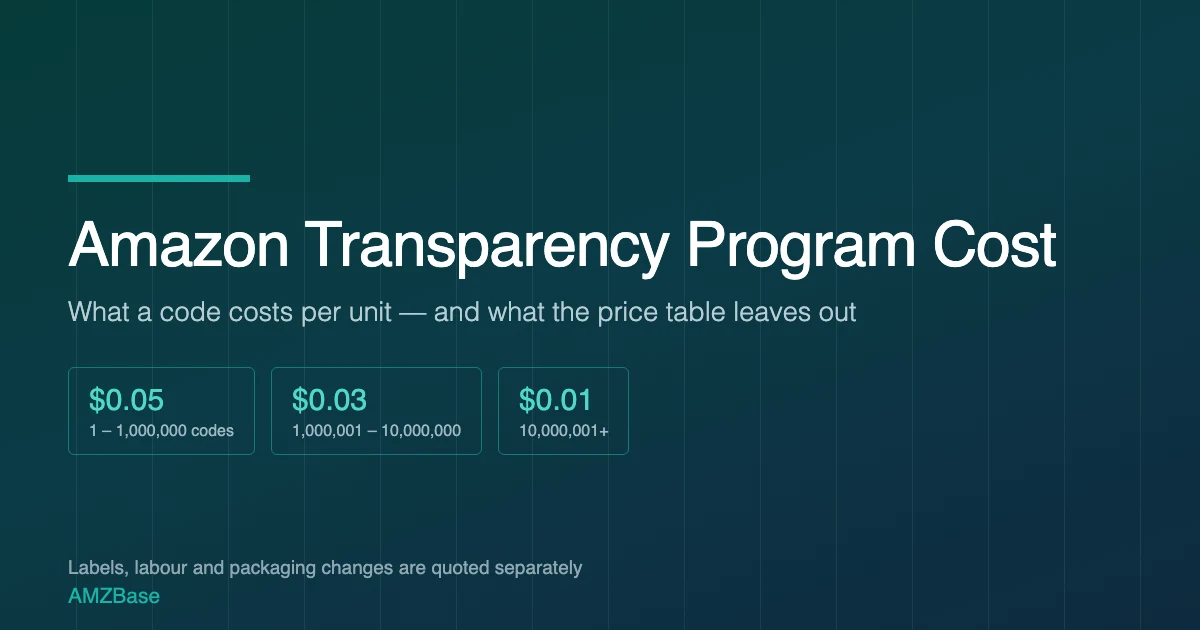
Amazon publishes the price of a Transparency code, and for almost every seller reading this it is $0.05 per unit. The published tiers drop to $0.03 above one million codes and $0.01 above ten million, there is no enrollment fee, no subscription and no minimum order — but the code is the only line item Amazon prices. Labels, application labour and packaging changes are quoted by your supplier, not by Amazon. All figures below were read directly off Amazon’s own pages on 2026-08-15.
One disambiguation before anything else: Transparency here means Amazon’s product serialization and anti-counterfeiting program for brand owners — unique scannable codes on physical units. It has nothing to do with Amazon’s advertising transparency reporting, which is a separate subject entirely.
What a Transparency code costs: Amazon’s published price table
Amazon states the pricing model in one sentence on the Transparency page: “Transparency has no enrollment costs, no subscription costs, and no minimums. You only pay when you order codes—not when you enroll in the program or add products.” The same FAQ adds that there is a per-unit cost both for Amazon-issued codes and for existing serial codes connected to Transparency, and that “Fees vary based on volume and geography.”
The table below is copied cell for cell from the “Transparency code pricing” block on Amazon’s Transparency page (data checked 2026-08-15):
| Price per code | Number of generated codes |
|---|---|
| $0.05 | 1 to 1,000,000 |
| $0.03 | 1,000,001 to 10,000,000 |
| $0.01 | 10,000,001+ |
Three conditions attach to that table, all stated by Amazon on the same page:
- The tier clock is your account anniversary, not the calendar year. Amazon’s wording: “Your annual code volume resets each year on the date of your account creation, and pricing tiers are based on cumulative volume within that period.”
- Adding or removing products costs nothing. “There are no costs for adding or removing products from the program.”
- The table is not universal. “Fees vary based on volume and geography” is Amazon’s own caveat, and this table is the one served on the US English page.
One thing the page does not resolve, and it matters near the first threshold: Amazon says tiers are based on cumulative volume, but never says whether crossing 1,000,000 reprices only the codes above the line or all codes in that year. Nothing public answers it, so model it neither way — ask when you order.
The “1 to 5 cents per code” figure circulating on seller blogs brackets the real table correctly but reads as more optimistic than it is: the 1-cent end requires more than ten million codes inside a single anniversary year. Under a million units, the price is the top tier.
The four costs the price table leaves out
Amazon prices the code. It does not price getting that code onto a unit, and that is where the money usually sits. Amazon’s page lists seven application methods and who each suits — self-print labels, pre-printed labels from partners, service providers and co-packers, printing directly on packaging, print workflow software, bringing your own codes, and regional integration partners for China only.
Four cost lines follow, none of which Amazon quotes:
- The physical label. Self-printing means label stock plus a printer. Pre-printed serialized labels come from third-party vendors — Amazon’s Transparency Service Provider Network lists partners by region, which is where quotes come from.
- Application labour. Someone applies the label to every unit: an added station and a negotiated per-unit rate at a contract manufacturer, a line on the invoice at a co-packer. If you already pay a prep centre, this is the same conversation as FBA labelling — see the FBA prep software guide for how that layer is priced.
- Packaging artwork changes. Printing codes onto primary packaging is the method Amazon lists as suited to “enterprise brands seeking lowest per-unit cost with upfront investment” — plates, artwork, and variable-data printing at the packaging supplier.
- Failures and rework. Amazon states that a unit failing a Transparency check triggers an investigation and a notification to you. Mislabelled inventory becomes stranded inventory, and that cost is your own.
A cost model you can fill in with your own quotes
The model below uses only publicly available inputs. The code fee row is real, taken from Amazon’s published table; every other row is deliberately blank because no public source prices it. Replace the blanks with your own quotes — that is the point of the sheet, not a placeholder for a number that exists somewhere else.
| Line item | Source of the number | 10,000 units/yr | 50,000 units/yr | 250,000 units/yr |
|---|---|---|---|---|
| Amazon code fee at $0.05/code | Amazon published table, checked 2026-08-15 | $500 | $2,500 | $12,500 |
| Label stock or pre-printed labels | Your vendor’s quote per 1,000 labels | — | — | — |
| Application labour or co-packer fee | Your factory or co-packer, per unit | — | — | — |
| Packaging artwork or plate change | One-off, only if printing on packaging | — | — | — |
| Rework and stranded-unit allowance | Your own scrap rate assumption | — | — | — |
Assumptions in the code-fee row, stated so you can change them: every unit manufactured gets a code (Amazon requires the ability to code every unit you make regardless of where it sells, so code volume tracks production, not Amazon sales); all volumes stay inside the first tier; the US English price table applies.
The shape of the sheet is the point: the decision that moves your per-unit cost is the application method, not the code price. The code is fixed at a nickel; the gap between a hand-applied label and an in-line printed code is negotiated with your supplier.
Transparency enrollment requirements: the three-item gate
Amazon lists three requirements to enrol, verbatim from the eligibility panel on the Transparency page (checked 2026-08-15):
- An Amazon Brand Registry account associated with your brand’s trademark and assigned the “rights owner” role
- An active, registered trademark for your brand
- A Global Trade Item Number (GTIN) for each product you want to enroll in Transparency
The second item is the one that catches people. Brand Registry itself accepts a pending trademark application in some cases; Transparency’s stated requirement is an active, registered mark. If your brand got into Brand Registry on a pending application, that is not automatically enough here. The registry side of that gate is covered in the Amazon Brand Registry guide, and if the GTIN line is the blocker, the barcode requirements guide covers where GTINs come from and when an exemption applies.
A second layer of conditions depends on code type. For Amazon-issued codes, Amazon requires “the ability to add codes to every unit you manufacture, regardless of where the units are sold.” For connecting your own existing serial numbers, the stated requirements are: unique codes per unit for a given GTIN or SKU; externally scannable 1D, QR or 2D barcodes on the same side of the packaging as the GTIN; numbers 7 to 20 characters long; and the ability to share all serial numbers for that GTIN or SKU with Amazon.
One step between enrolling and being protected is easy to miss. Amazon’s step three is an operational performance review — initiated through Transparency support for self-fulfilled orders, or through the portal for FBA, where codes are scanned as units arrive at the fulfilment centre. Amazon’s note: “Transparency protections aren’t active until your product passes the operational performance review.”
A boundary on this whole section: the detailed onboarding guide, rights-owner documentation and country-specific screens all sit behind an Amazon login, and this article reports only what the public pages state. Where your account shows something different — geography-specific pricing being the likeliest place — your account is the authority.
Where Transparency applies: 10 stores, 10 eligible origins
Amazon lists these as Transparency-supported stores: the US, Canada, Germany, France, Italy, Spain, the UK, Australia, India, and Japan. Eligible enrollment origins are the US, Canada, Germany, France, Italy, Spain, the UK, India, Japan, and China. Amazon notes that brands from Australia are not currently eligible to enroll, while brands enrolled from other eligible origins still receive protection in the Australia store.
Enrollment is not per-store. Amazon’s FAQ answers this directly: once you enroll products, apply codes and enable protections, products are protected across all Amazon stores where Transparency is supported. If your main store is not on that list of ten, coding units buys you no listing protection there.
Transparency vs Project Zero vs Brand Registry: three different things
These three get blurred constantly. They are separate programs with separate gates, and only one costs money.
| Brand Registry | Project Zero | Transparency | |
|---|---|---|---|
| What it is | Brand-owner account layer and reporting channel | Self-service counterfeit-listing removal plus enhanced automated protections | Per-unit serialization, verified at listing and shipping |
| Cost | Amazon states it is a free program | Free; removal tool and automated protections at no cost | Per code, $0.05 down to $0.01 by annual volume |
| Gate | Pending or registered trademark from a designated office | Rights owner in Brand Registry; Report a Violation used in the last six months with at least a 90% acceptance rate; policy-compliant history | Rights owner in Brand Registry; active registered trademark; GTIN per product |
| Coverage | Offices with a corresponding Amazon store | 22 stores listed by Amazon | 10 supported stores |
| How you get in | Apply with a qualifying mark | Amazon states it invites brands automatically once they meet the criteria | Direct enrollment with Brand Registry credentials |
The free one and the paid one are not alternatives. Amazon’s Project Zero page describes its third capability as combining instant counterfeit removal “with serialization powered by Transparency” — the serialization under Project Zero’s prevention layer is Transparency, billed per code. Project Zero also carries an ongoing obligation Transparency does not: brands “must maintain an accuracy rate of at least 99% in order to maintain access to Project Zero.”
For the Project Zero side specifically, there is a dedicated breakdown at AMZFinder’s Project Zero guide. Chinese-language readers will find both programs covered at SellerHow.
Does serialization actually stop hijackers?
Amazon’s stated mechanism is narrow and specific, and worth reading literally. Once products are fully protected by Transparency, Amazon says, “they cannot be listed in Amazon’s Transparency-supported stores without valid Transparency codes that match the enrolled product.” Amazon also describes checks that identify and prevent shipment of materially different products — differing in materials, compatibility, colour, or language — or that don’t meet the regulatory requirements of Transparency-supported stores.
Four limits follow from Amazon’s own text, none of them hypothetical:
- Protection is per enrolled product, not per brand. Amazon states brands choose which of their products to serialize, so anything unenrolled is unchanged.
- Protection is per supported store. Outside the ten stores listed above, the listing check does not exist.
- Protection starts after the operational performance review, not at enrollment. Between the two, you are paying for codes with no active protection.
- Customer-facing verification depends on code type. Amazon states app scanning and the customer engagement features are not available for products connected using existing serial codes — only for Amazon-issued codes. Amazon also states some brands may be eligible for a Transparency badge on the product detail page.
What Transparency does not do is deal with a hijacker already on your listing today, or with the response playbook once one appears — that is a different set of actions, covered in the Amazon listing hijacking guide. Serialization is the prevention layer for units you have not manufactured yet.
Frequently Asked Questions
Is the Amazon Transparency program free to join?
Joining is free. Amazon states there are no enrollment costs, no subscription costs and no minimums, and no cost for adding or removing products. You pay per code when you order codes — $0.05 each in the first tier (checked 2026-08-15).
Does the price per code change by country?
Amazon states that “Fees vary based on volume and geography” without publishing per-country tables. The tiers quoted here are from the US English page. Confirm your own pricing in the Transparency portal before modelling a non-US launch.
Do I need a registered trademark, or is a pending application enough?
Amazon’s stated Transparency requirement is an active, registered trademark. Brand Registry itself can accept a pending application in some cases, so passing that gate does not guarantee you pass this one.
Can I use my own serial numbers instead of Amazon’s codes?
Yes — Amazon supports connecting existing serial codes, provided they are unique per unit, externally scannable in 1D, QR or 2D format on the same side of the packaging as the GTIN, and 7 to 20 characters long. The trade-off Amazon states: app-based customer authentication and customer engagement features are not available for products connected this way.
Does enrolling in Transparency get me into Project Zero?
No. They are separate programs with separate gates. Project Zero eligibility runs on your Report a Violation history — at least a 90% acceptance rate on reports filed in the last six months — while Transparency runs on trademark status and GTINs.
Bottom line
For a brand shipping under a million units a year, Amazon’s Transparency price is a flat $0.05 per unit, published openly, with no fee to enrol and no minimum. That number is easy. The number that decides whether the program is affordable is the one Amazon does not publish: what it costs to get a code onto every unit you make. Get the label and application quotes first, then multiply — the nickel is rarely the deciding factor.
All Amazon figures here were read from the linked Amazon pages on 2026-08-15; the legacy brandservices.amazon.com domain now redirects to them. Terms change — your Transparency portal is the authority for your account.