Amazon PPC automatic vs manual is a choice about who selects the targets, not which campaign is guaranteed to be cheaper. With Sponsored Products automatic targeting, Amazon matches ads to shopper queries and products; with manual targeting, you choose keywords or product targets. Amazon’s targeting guide, checked November 10, 2026, says you cannot change a live campaign’s targeting strategy: moving from automatic to manual requires a new campaign.
Choose automatic when the next job is discovering relevant demand. Choose manual when you already have a target hypothesis that deserves deliberate control. Use both when each has a distinct job and you can fund and evaluate those jobs separately.
Source checked November 10, 2026: Amazon Ads’ Sponsored Products targeting guide. This comparison concerns Sponsored Products targeting, not Sponsored Brands automatic collections, software automation, or dynamic bidding. It is documentation-based, not a performance test from a seller account.
Amazon PPC automatic vs manual: what control changes
The practical distinction is the targeting instruction. Amazon’s guide, checked November 10, 2026, describes automatic targeting as Amazon matching the advertised products to shopping queries and products. Manual targeting lets advertisers choose keyword or product targets. Both still require an advertiser to decide what the campaign is supposed to achieve.
| Decision | Automatic targeting | Manual targeting |
|---|---|---|
| Target selection | Amazon determines matches to queries and products | Advertiser selects keyword or product targets |
| Best starting question | What relevant demand have we not identified? | What specific demand or product context do we want to reach? |
| Useful input | An accurate product listing and a bounded discovery objective | A researched or observed target hypothesis |
| Useful output | Search-query and product-context discoveries to evaluate | Evidence about deliberately selected targets |
| Continuing work | Review relevance, spending, and discoveries | Review target choices, coverage, bids, and exclusions |
| Main interpretation trap | Treating Amazon’s matching as proof of commercial value | Treating hand-picked targets as proof of profitability |
Automatic does not mean unattended. Manual does not mean every impression or search query has been individually chosen. A manually selected keyword still needs a match-type decision; the selected keyword and the eventual shopper search term are not interchangeable labels.
Manual targeting is also broader than keyword lists. Amazon’s guide checked November 10, 2026, includes product targeting. If an automatic campaign reveals a useful product context, the handoff may belong in a manual product-targeting workflow, not in a keyword campaign with a product identifier pasted into a text field.
Bidding is a separate axis. Choosing manual targeting does not by itself choose a fixed bidding strategy, and automatic targeting is not a synonym for dynamic bidding. Keep the targeting decision and the bid-behavior decision separate in the campaign brief. Otherwise, a later performance change can be attributed to the wrong control.
Choose the next job with a decision matrix
Choose the starting model from the evidence you have and the decision you need to make. A new product can have a well-researched manual hypothesis. An established product can still need automatic discovery for unfamiliar uses or shopper language. Product age alone does not settle the choice.
| Your situation | Starting choice | Evidence to collect before the next change |
|---|---|---|
| Little knowledge of actual shopper wording | Automatic discovery | Relevant observed queries and product contexts |
| A clear shortlist of relevant search phrases | Manual keyword targeting | Results for the selected targets and their resulting queries |
| A defined set of competing or complementary products | Manual product targeting | Results for the selected product contexts |
| Useful discoveries plus unanswered demand questions | Both, with separate jobs | Manual target results and continuing discovery results |
| Spend is weak in an existing automatic campaign | Diagnose before adding manual spend | Relevance, offer readiness, and the source of the weak result |
| Very limited funds for observation | One bounded question first | Enough evidence to answer that question without scattering spend |
The last row matters more than a standard automatic/manual budget split. If splitting funds leaves both campaigns with ambiguous results, the structure has created activity rather than knowledge. Fund the most important unanswered question first, then add the second role when it has a clear purpose.
For example, suppose a hypothetical insulated lunch bag has no advertising history but the seller knows a narrowly defined use case. Manual targeting can test that use case directly. Automatic targeting can explore other relevant wording, but it should not be added merely to complete a fashionable campaign template.
Conversely, a mature product with reliable manual targets can keep a discovery role. The requirement is a reason to keep learning, not a rule that automatic campaigns must be retired once manual campaigns exist.
Write the chosen job in one sentence: “Find relevant commuter-lunch queries we have not selected,” or “Evaluate these known commuter-lunch targets.” If the two campaigns have identical job descriptions, refine the brief before launching another one.
You cannot convert the live targeting model in place
Amazon’s Sponsored Products guide, checked November 10, 2026, states that targeting is selected when creating the campaign and cannot be changed once the campaign is live. A different targeting strategy requires a new campaign. A handoff therefore creates a new operating destination; it does not relabel the original campaign.
This distinction changes the work plan. Preserve the original campaign’s identifiers, observation window, discoveries, and current settings. Build the manual destination with its own targeting instructions. Then decide what the source should continue doing.
Do not assume creating the destination transfers the old campaign’s evidence into a directly comparable new history. Keep the source report as the origin record and evaluate the new campaign’s own results separately. A different targeting instruction can produce a different mix of traffic even when the advertised product stays the same.
The source does not have to disappear. It can continue discovery, be narrowed through exclusions, be reduced, or be paused depending on its remaining job. None of those actions follows automatically from the existence of a manual campaign.
For account-wide naming and organization, use the campaign-structure guide. This comparison stops at the choice of model and the handoff between them.
Decide whether another control model earns its own campaign
Amazon’s targeting guide, checked November 10, 2026, identifies automatic search term reports as a source of manual target ideas. The comparison decision is whether those ideas now need advertiser-selected control, not how many rows can be moved. For the detailed evidence record, destination checks, and source exclusions, use the automatic-campaign handoff instructions. Keep that operational procedure separate from the model choice here.
Add control when the target question is specific
A manual campaign earns its place when you can identify what you want to select and why that selection changes the decision. For a hypothetical replacement water filter, the question might be whether shoppers using a specific compatibility phrase are worth reaching deliberately. An automatic campaign can reveal that phrase; a manual instruction lets you assess the selected hypothesis. It does not promise the same traffic or a better result.
If you cannot yet distinguish the intended demand from irrelevant compatibility searches, another campaign may only spread uncertainty. Continue the bounded discovery question or clarify the product’s fit first. When the hypothesis is a product context rather than shopper wording, assess manual product targeting. For phrase coverage, use the keyword match-type guide.
Keep both only when they answer different questions
Use this model-choice test before approving another campaign:
| Proposed combination | Distinct decision value | Reason to defer |
|---|---|---|
| Automatic discovery plus manual keywords | Explore unfamiliar language while evaluating selected phrases | Both briefs merely say to increase sales |
| Automatic discovery plus manual products | Explore demand while assessing named product contexts | No clear product relationship supports the selected targets |
| Manual only for the current question | Direct funds toward a defined target hypothesis | The target list is a guess that cannot be reviewed meaningfully |
| Automatic only for the current question | Concentrate observation on finding relevant demand | Existing discoveries already require deliberate target-level follow-up |
The decision is reversible at the allocation level, not by converting the live targeting setting. You can reassess which campaign deserves further funds after reviewing its evidence. A new manual destination is therefore a commitment to evaluate a defined instruction, not a commitment to retire automatic targeting permanently.
Before adding it, ask whether its result could change your next action. If either outcome would leave the same vague plan, improve the question first. If the selected target succeeds, decide what that establishes about that target; if it fails, decide what would justify revising or stopping the hypothesis. Neither outcome alone settles which model is universally better.
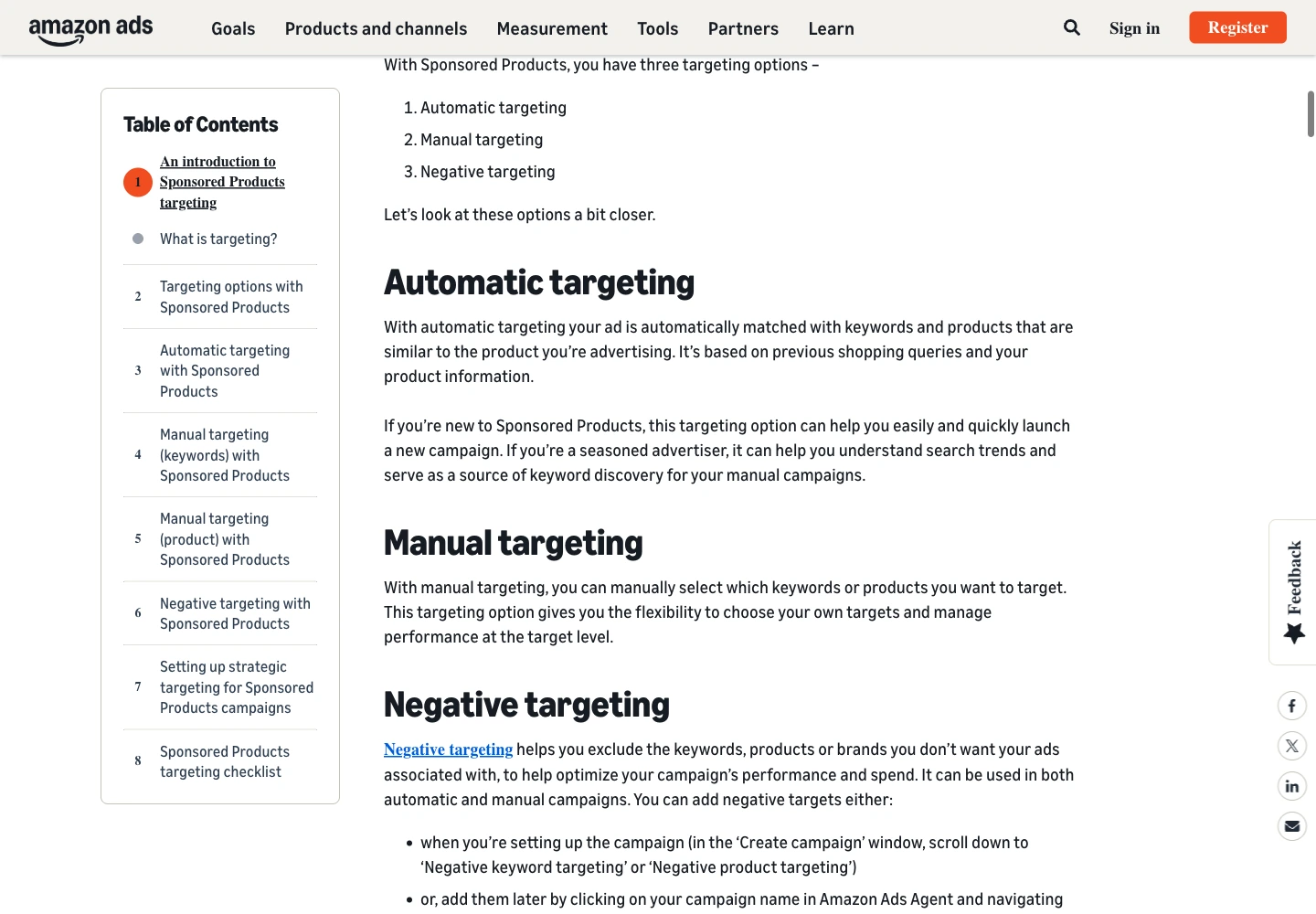
Amazon Ads public targeting guide, captured November 10, 2026. The visible automatic and manual definitions distinguish who selects targets; this is a documentation screenshot, not a campaign-settings screen. Source: Amazon Ads.
Compare outcomes without declaring a universal winner
Automatic and manual campaigns often answer different questions. A discovery campaign spends to identify relevant opportunities; a manual campaign tests a selected set. Comparing their blended results without the job descriptions can make useful discovery look wasteful or a narrow manual campaign look more scalable than it is.
Use a common review window where practical and record meaningful differences: advertised product, price or offer changes, availability, target coverage, and campaign objective. If those change together, describe the comparison as an operating observation rather than a clean test of targeting models.
Evaluate on two levels:
- Commercial result: whether the spend and attributed outcome fit the product’s economics and campaign objective.
- Decision value: whether the campaign answered its assigned question and produced a useful next action.
A discovery campaign can supply relevant candidates while still spending more than its objective supports. Useful learning does not erase that cost. A manual campaign can report a strong result for a small target set while leaving substantial demand unexplored. Efficiency does not prove coverage.
There is no universal click threshold or elapsed-time rule in this framework. Set the observation allowance from your product economics and the question’s importance. Before acting, check whether the reporting window is sufficiently complete and whether a small number of outcomes is carrying the conclusion.
If the manual destination underperforms its source, investigate the specific instruction. Was the keyword interpreted differently? Did the match type widen or narrow coverage? Did the product target represent the intended context? Was the offer different? Those questions are more actionable than concluding that manual targeting “does not work.”
If both models perform weakly, investigate shared inputs before duplicating more campaigns. Product relevance, the offer, and the evidence available may be the constraint rather than the choice between automatic and manual.
Mistakes to catch before adding another campaign
Treating manual as the graduation prize. The destination is useful because it gives a selected hypothesis control, not because it is inherently more advanced. Keep automatic discovery when it continues to answer a funded question.
Confusing automation with targeting. A tool can automate changes to manual campaigns. That does not turn their targeting model into Amazon’s automatic targeting. Describe both the target-selection model and any management automation separately.
Pausing the source too early. Creating a manual target is not proof of delivery. Confirm the destination’s operation and decide what coverage you intend to retain before narrowing the source.
Copying the whole report. A candidate list needs relevance and commercial review. Duplicating every observed query replaces Amazon’s broad discovery with a broad manual maintenance burden.
Before proceeding, make sure you can name the next campaign’s job, identify its input evidence, choose the correct target type, preserve the origin record, and explain the source campaign’s future role. Those decisions make the handoff understandable without reconstructing the entire account.
Frequently Asked Questions
Is automatic or manual Amazon PPC better for beginners?
Automatic targeting is useful for discovering relevant queries and products. Manual targeting is useful when a beginner already has a specific target hypothesis. Choose the question you can fund and evaluate, rather than using experience level as the only rule.
Can I switch an automatic campaign to manual?
Amazon’s Sponsored Products targeting guide, checked November 10, 2026, says a live campaign’s targeting strategy cannot be changed. Create a new campaign for the new strategy, preserve the source evidence, and make a separate decision about continuing discovery.
Should I run automatic and manual campaigns together?
Use both when they have distinct discovery and selected-target jobs. Give each an objective and review condition. Neither the model name nor the presence of both campaign types guarantees lower costs or better returns.