Amazon Coupons vs Deals vs Price Discounts (2026)
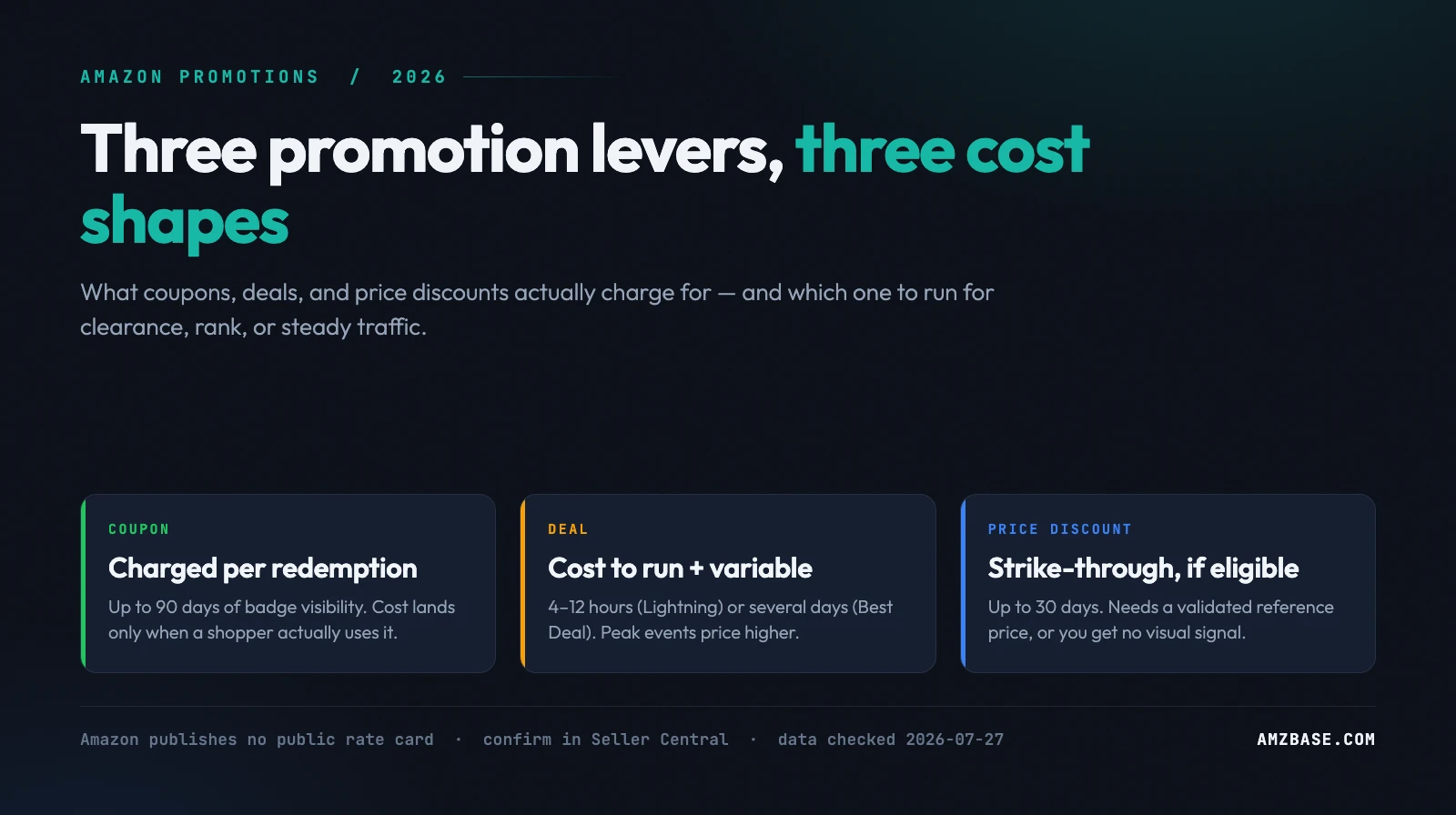
The short answer: coupons carry a redemption cost charged every time a shopper uses one, deals carry a cost to run plus a possible variable percentage of deal sales with a cap, and price discounts may carry a cost too — but Amazon publishes no public rate card for any of them. Every figure quoted on third-party blogs is a reconstruction, and those reconstructions contradict each other. The number that governs your P&L is the one Seller Central shows before you submit, so this guide is built around reading that screen correctly rather than around numbers nobody can source.
Data checked 2026-07-27 against Amazon’s seller-facing pages on sell.amazon.com (linked throughout). Amazon’s detailed promotion fee schedules sit behind the Seller Central login and are not publicly readable; where that is the case this guide says so instead of substituting a third-party estimate.
The three levers at a glance
| Coupon | Lightning Deal / Best Deal | Price Discount | |
|---|---|---|---|
| What the shopper sees | Clip-to-save badge | “Deals Badge” and special merchandising | Strike-through reference price |
| Where it appears | Detail pages, search results, Amazon Deals page, shopping carts | Product detail pages, search results, the Amazon Deals page; Lightning Deals are also tied to the product’s category | Search results and detail pages, when a validated reference price exists |
| Duration | Up to 90 days | Lightning Deal: 4–12 hours, set by Amazon. Best Deal: 1–14 days | Up to 30 days |
| Rating requirement | 3.5 stars or higher | 4 stars or higher | Not stated publicly; SKU-level eligibility applies |
| Cost structure | Redemption cost each time it is used, separate from your budget | Cost to run the deal, plus a possible variable percentage of sales with a cap | “There may be a cost to run a price discount” |
| Budget control | You set $100–$10 million | Committed units × savings per unit, plus deal cost | Limited number of units |
| Published rate | None public | None public | None public |
Sources: Amazon’s guide to running seller promotions, coupons, and deals and its pages on costs and budgets for promotional methods and promo codes. Data checked 2026-07-27. All three require a Professional selling plan, which Amazon prices at $39.99 a month plus selling fees.
What Amazon actually publishes about promotion costs
Amazon’s public seller pages describe the shape of each cost but publish no rates. Verbatim, as of 2026-07-27:
- On coupons: “Your budget won’t be reduced by any additional costs to run or participate in a promotion or coupon. Those costs, if any apply, are separate from your budget allocation.” The promotions guide adds: “Additionally, there is a redemption cost each time a coupon is used.” Neither page gives the amount.
- On deals: “The cost may depend on whether you run the deal during a designated peak selling event like Prime Day, Black Friday, or Cyber Monday.” Amazon publishes the arithmetic without the inputs: "…multiply the number of units you commit to the deal by the amount of customer savings you’re offering per unit, then add the cost to run the deal. If a variable cost applies, then you’ll also need to multiply the number of committed units by the relevant percentage of sales and either add that amount or the capped amount to your total cost."
- On price discounts: “There may be a cost to run a price discount.” Here too Amazon gives the arithmetic and withholds the input: “multiply the amount of customer savings you offer per unit by the number of units you expect to sell, then add the cost to run the discount, if there is one.”
So Amazon has publicly confirmed, as of 2026-07-27, that deal pricing includes a fixed component plus a possible variable percentage with a cap, and that peak events price differently. It has not published what the component, the percentage, or the cap are — those appear during creation in Seller Central.
About the specific numbers quoted elsewhere
Search for coupon costs and you will find confident figures. Two of the three below describe the same fee; the third describes a different model entirely — and none of them can be settled against a publicly readable Amazon page:
- $0.60 per redeemed unit, raised from $0.50 in 2024 (Velocity Sellers, checked 2026-07-27).
- $0.60 standard / $0.50 Subscribe & Save, plus a $2,000 cap on variable coupon fees for coupons created on or after November 5, 2025 (Nova Analytics, checked 2026-07-27; it does link two Amazon Seller Central help pages as sources, but both redirect to the Seller Central login, so a reader cannot check the figure).
- A third strand says the per-redemption model was replaced, from June 2025, by a $5 flat fee per coupon plus 2.5% of coupon sales (My Amazon Guy, checked 2026-07-27; no Amazon page linked).
Two accounts that agree, one that contradicts both, and no public Amazon page to settle it. Treat all three as third-party claims and read your own creation screen instead — it reflects your marketplace, your date, and your product.
Coupons: continuous visibility, priced per use
A coupon gives “a percentage off or a specific amount of money off a single product or set of products.” One coupon covers up to 200 ASINs, you can cap uses per customer, and coupons expire after a maximum of 90 days. Eligibility: Professional selling plan, an overall rating of at least 3.5 stars, plus product-level rules.
Two structural facts drive the economics:
- Cost scales with redemptions, not impressions. A coupon seen a million times and clipped by nobody costs nothing — the low-risk way to buy a badge in search results.
- The budget is a forecast, not a hard limit — Amazon says so explicitly. It is “for planning purposes only and isn’t a hard limit,” and spending “can exceed your budget.” The brake is partial: “We take your promotion or coupon offline when it reaches 80% of the budget you set in Seller Central” — the remaining 20% covers shoppers who already clipped it, who can still redeem “within a window of approximately 30 minutes in our US store…” after discovery is switched off. Amazon’s own verdict is that “any level of budget overshoot should be expected.” Budgets run from $100 to $10 million, and coupon costs sit outside that budget, which covers only customer savings.
Amazon’s own Prime Day preparation advice is to “discount the product more than 5%” and schedule the coupon to coincide with the event.
Lightning Deals and Best Deals: concentrated velocity, priced per event
Deals buy what a coupon cannot: placement inside a destination where shoppers arrive already intending to buy discounted things — a “Deals Badge” plus visibility on “product detail pages, in search results, and on the Deals page.” Lightning Deals are additionally “connected to specific categories,” so correct categorization is part of being found. Both types need a Professional selling plan and a 4-star or higher rating, and only select products qualify.
- Lightning Deals run 4 to 12 hours, “as determined by Amazon.” You do not choose the length, and that compression is the point: it concentrates unit velocity, the input that moves sales rank. The Amazon BSR guide covers why a 6-hour spike and a 6-day drip are not interchangeable.
- Best Deals “can run anywhere from 1 to 14 days” and apply automatically with no code — trading peak velocity for sustained exposure, which suits clearance better than launches. That range, not the deal type, is the real lever when you are picking days of exposure.
The cost model, per Amazon’s formula: committed units × savings per unit, plus the cost to run the deal, plus (if a variable cost applies) committed units × the relevant percentage of sales, capped. Committed units are your main control, but not a ceiling: “A deal deactivates when it sells 90% of its committed units,” and Amazon warns that “it’s possible to sell more units if you receive a large volume of orders in a short amount of time after the deal deactivates. So be sure to factor this into your calculations.” Same soft-limit behavior as the coupon budget.
Peak events cost more, and that premium sits on top of a separate holiday peak fulfillment surcharge that FBA sellers pay from mid-October — the 2026 fee changes guide has the dated breakdown. A Q4 deal absorbs both.
Price Discounts: the strike-through, priced quietly
A price discount is a “time-bound campaign in which you can offer discounted prices on your products for up to 30 days on a limited number of units,” targetable at Prime customers or everyone. The visible payoff is strike-through pricing in search results and on detail pages — but only when a validated reference price exists. Without it, you have cut your price and bought no visual signal at all.
It is not a cheaper coupon; it is a different instrument:
- It changes the offer price itself, so it interacts with the Featured Offer calculation — the Featured Offer / Buy Box guide covers what price actually contributes.
- It has a cost, and Amazon publishes only the arithmetic. “There may be a cost to run a price discount,” reviewable “during the discount creation process in Seller Central.” The estimate Amazon gives: customer savings per unit × units you expect to sell, plus the cost to run the discount if there is one. Assuming it is free because no badge fee is obvious means budgeting from an assumption rather than a page.
- Not all SKUs are eligible, and reference-price validation is the usual reason a discount runs without producing a strike-through.
Past 30 days, sustained price movement is a repricing problem rather than a promotion problem — the repricer comparison covers the tools built for that.
Promo codes are free to create — promotion costs sit outside the budget, not at zero
Worth separating carefully, because the two claims are often merged. On promo codes, Amazon is unambiguous: “It’s free to create a promo code.” On percentage-off and BOGO promotions, it says something narrower: “Your budget won’t be reduced by any additional costs to run or participate in a promotion or coupon. Those costs, if any apply, are separate from your budget allocation.” That places promotion costs outside the budget line — it does not say there are none.
The catch is discovery — you distribute codes yourself through social channels, email, influencers, or Amazon Associates, and Amazon is explicit that codes do not apply to coupons or deals. Read that as a division of labor: you pay Amazon for placement, and a discount you drive traffic to yourself costs you nothing to set up.
Decision matrix: what to run for which goal
| Goal | First choice | Why | What not to do |
|---|---|---|---|
| Clear aged or excess inventory | Best Deal, or a price discount if a validated reference price exists | Sustained days of exposure, with committed units as your main control on cost | Not a Lightning Deal — 4–12 hours at event pricing rarely clears meaningful depth |
| Push rank on a launch or a slipping position | Lightning Deal, stacked with a coupon for search-results CTR | Rank responds to concentrated recent velocity; the compressed window is the feature | Not a 30-day price discount — the same units spread over a month are a much weaker velocity signal |
| Everyday traffic and conversion lift | Coupon | Up to 90 days of badge visibility, cost incurred only on redemption, 80% budget stop | Not back-to-back deals — that is event pricing for baseline demand |
| Move volume to your own audience | Promo code (percentage-off or BOGO) | Free to create, and no placement to pay for | Don’t expect on-Amazon discovery; codes are not surfaced |
| Peak event (Prime Day, BFCM) | Deal submitted early, coupon scheduled to coincide | Amazon’s guidance: discount more than 5% and align coupon dates with the event | Don’t discover the peak premium at submission — model it first |
Two inputs decide most cases: days of exposure needed, and units you will commit at the discounted price. Coupons optimize the first, deals the second; price discounts do neither especially well but change the number the shopper compares against.
Before committing units, confirm the discounted price still clears your landed cost — the FBA fees and profit guide walks the fee lines, and the free FBA fee calculator comparison covers which free tools model storage and returns.
Common mistakes
- Budgeting the savings and forgetting the promotion cost. Coupon costs are separate from the budget allocation, so true exposure is savings plus cost — and the 80% deactivation plus the ~30-minute grace window means even the savings half can overshoot.
- Running a price discount with no validated reference price. You give up margin and get no strike-through. Confirm it renders before extending.
- Using a Lightning Deal for clearance. Four to twelve hours at event pricing against aged stock is the most expensive way to not clear it — and stock that has aged into a real problem is usually a forecasting failure upstream, which the restock software comparison covers.
- Stacking discounts without checking compound depth. A coupon on a price discount on a deal price compounds. Nothing prevents it; your margin absorbs it.
- Not reconciling after the fact. Promotion-attributed sales have to be measured against actual margin, and against the alternative — ad spend buys clicks while coupon cost is charged only on conversion. See the profit analytics tools comparison and the PPC playbook.
Promotion budget checklist
Work through this before you submit anything.
- Landed cost confirmed at the discounted price — referral fee, fulfillment fee, and any current surcharge included — and a floor price set below which you would rather not sell.
- Units committed written down. For deals this is the primary control on your exposure.
- Promotion cost read off the creation screen and recorded per SKU and per campaign — the number no public page can give you.
- Variable component checked — whether a percentage of sales applies, and what the cap is.
- Peak premium accounted for if the dates touch Prime Day, Black Friday, or Cyber Monday, plus the separate Q4 fulfillment surcharge if you are FBA.
- Stacking audited — no other active promotion compounds on the same ASIN unless intended.
- Inventory depth verified against committed units, so a successful deal doesn’t strand you out of stock at full price.
- Post-promotion plan written: what the price returns to, and on what date.
- Review capture set up for the order spike — a deal that lands hundreds of units in an afternoon is also the largest review opportunity of the quarter. Compliant review-request automation is a separate tool category; AMZFinder compares the review and feedback management tools in it (checked 2026-07-27).
Frequently Asked Questions
Is a coupon cheaper than a Lightning Deal?
On cost structure, usually yes: a coupon’s cost is incurred per redemption, while a deal carries a cost to run regardless plus a possible variable percentage. But they buy different things — a coupon buys a badge on surfaces shoppers already visit, a deal buys placement inside a discount destination. Amazon publishes neither rate, so the comparison for your SKU is made on the Seller Central creation screens. Data checked 2026-07-27.
How much does an Amazon coupon cost in 2026?
Amazon’s public pages state a redemption cost is charged each time a coupon is used, and that this cost is separate from your budget allocation — but they do not publish the amount, and third-party figures contradict one another. The authoritative number for your account, marketplace, and date appears during coupon creation in Seller Central. Data checked 2026-07-27.
Do price discounts cost anything?
Amazon states: “There may be a cost to run a price discount.” It does not publish an amount or the conditions under which the cost applies. Check the creation screen. Data checked 2026-07-27.
What rating do I need to run deals?
Coupons require an overall rating of at least 3.5 stars; Lightning Deals and Best Deals require 4 stars or higher. All require a Professional selling plan, with product-level eligibility rules on top. Data checked 2026-07-27 against Amazon’s seller promotions guide.
Are promo codes really free?
Amazon states: “It’s free to create a promo code. All you need is an Amazon selling account.” The trade-off is discovery — Amazon does not surface promo codes the way it surfaces coupons and deals, so you supply the traffic. Data checked 2026-07-27.
Conclusion
The honest comparison of Amazon coupons vs deals is not a table of fees, because Amazon does not publish one. It is a comparison of cost shapes: coupons charge on conversion and buy 90 days of badge visibility; deals charge to run plus a capped variable slice and buy a short burst of destination placement; price discounts change the compared-against price and may charge for the privilege. Pick by goal, not by which sounds cheapest — then read the cost on the creation screen, write it next to the committed units, and confirm the discounted unit still earns.
All Amazon statements quoted above were checked on 2026-07-27 against sell.amazon.com. Promotion rates vary by marketplace and by date and are not published publicly by Amazon — confirm yours in Seller Central before you submit.